In the mid-1970's safety glass became the required standard for all sliding glass doors, however older annealed plate glass still remains in some homes today and can be deadly.
http://chicago.cbslocal.com/2014/02/17/2-investigators-older-glass-windows-are-potentially-deadly/
Wednesday, March 19, 2014

Friday, February 28, 2014
THERMAL PANE GLASS MOISTURE REMOVAL
Cloudy Glass?
There are a few small businesses, which have the ability to remove the moisture from between the thermal panes of glass in windows for less than $150 each.
Using a special tool, they drill a small hole in the glass at two opposite corners, pump in some chemicals, rinse with a drying agent and plug the holes. They claim the moisture will not reappear for at least 20 years.
It is important that the business have enough liability insurance to cover the cost of glass replacement should a crack or chip in the glass occur during the procedure.
Please note that this service removes only the moisture and will not remove any milky streaks.
Also, this procedure cannot be performed on tempered safety glass, which includes all sliding thermal pane glass patio doors.
Wednesday, February 12, 2014
SLIDING PATIO DOOR MAINTENANCE
All sliding doors require periodic maintenance and cleaning. Each manufacturer provides detailed information about how their products are best maintained. http://www.steinerhomesltd.com/manuals/windows/jeldwen_vinyl_windows_care.pdf
Unfortunately, home owners rarely take the time to access such information.
Unfortunately, home owners rarely take the time to access such information.
Wednesday, February 5, 2014
PELLA WOOD ROT
If your solid wood core sliding patio door is in close proximity to a pool, pond, fountain, stream, river, lake, waterfall or ocean... it will eventually rot. It doesn't matter whether your door has external cladding or not.

The deterioration and swelling of the wood core is most apparent at the bottom frame of the operating door(s) and/or stationary panel(s) and, although it can be apparent within 10 years, in most cases, it can take over 20 years for the softened wood to no longer support the rollers.
However, wood rot has been found to be severe in less than ten years with some Pella products and is not covered under their 10-year warranty. A class-action suit has attempted to address this consumer concern. http://www.youtube.com/watch?v=QH_G8cIvTb4
If caught in time, the deteriorating lower frame can be cost-effectively rebuilt.
Tuesday, January 7, 2014
NEW PATIO DOORS LEAK AIR
Some brand new sliding patio doors (usually solid wood core) have been found to leak air where the operating door interlocks with the stationary panel.
This often does not become apparent to the owner until cold weather sets in.
The reason cold air is felt blowing in around this interlock area is because the doors are not fully interlocked and the weather seal is not fully engaged. This can occur even if the operating door is fully closed and securely locked.
The cause is due to the fact that the patio door system is likely about 1/4" too wide for the opening, the door was installed to be plumb and not square (and a 1/4" was lost)... or, the manufacturer made one or more of the components a little too wide and the installer did not have enough of a financial cushion in the job to take the time to correct the error. http://www.dehavenconstruction.com/vinyl-window/window-installation-errors-problems.php
The solution is to remove the stationary panel, plane the vertical jamb side and replace.
Friday, December 27, 2013
MULTI-POINT LOCKS
Multi-Point locking mechanisms used on sliding patio doors have been manufactured by Truth, Marvin, Fuhr, Hoppe or a half dozen others. When the door is fully closed, the thumb turn latches at two, three or more points into or around keepers in the jamb.
Fifty percent of the time, maintenance issues with these high-security style locks can be contributed to the keepers, which may just be out of adjustment or alignment.
With these designs, the thumb turn cannot move the latches until the door is completely closed and a "plunger", protruding from the jam, presses against a "trap door" on the face of the mechanism, which releases the latches to move into place... thus, locking the door.
Or, with some manufacturers, the door handle needs to be held down as the door is closed in order to release the latches... and, then the latches can engage the keepers when the handle is released.
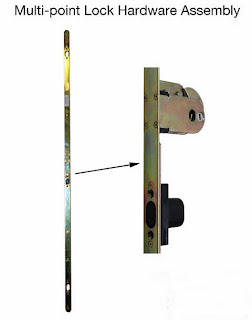
The other half of the time, maintenance issues are the result of bent latches or components internal to the locking mechanism. This usually happens when someone has tried to adjust the keepers or they gradually moved out of adjustment over the years. When the person closed the door and twisted the thumb turn to move the latches, the latches did not fully catch the keepers. Then, opening the door without twisting the thumb turn back to return the latches to the open positions, the door was closed again and the keepers hit and bent the mechanism which was still in the closed position.
You can take the entire mechanism apart and play with it for a couple of hours and you might be able to straighten out the bent components. But, you are better off just buying a whole new mechanism for a few hundred bucks.
Note: When ordering a new multi-point mechanism, you will need to measure the length, width, offset and possibly several other dimensions. The right one is not hard to find on the Internet.
Replacement of the entire mechanism can take less than one half hour and adjusting the keepers can take up to another half hour. Suggestion: Remove the keepers and then replace individually to adjust them one at a time.
Fifty percent of the time, maintenance issues with these high-security style locks can be contributed to the keepers, which may just be out of adjustment or alignment.
With these designs, the thumb turn cannot move the latches until the door is completely closed and a "plunger", protruding from the jam, presses against a "trap door" on the face of the mechanism, which releases the latches to move into place... thus, locking the door.
Or, with some manufacturers, the door handle needs to be held down as the door is closed in order to release the latches... and, then the latches can engage the keepers when the handle is released.

The other half of the time, maintenance issues are the result of bent latches or components internal to the locking mechanism. This usually happens when someone has tried to adjust the keepers or they gradually moved out of adjustment over the years. When the person closed the door and twisted the thumb turn to move the latches, the latches did not fully catch the keepers. Then, opening the door without twisting the thumb turn back to return the latches to the open positions, the door was closed again and the keepers hit and bent the mechanism which was still in the closed position.
You can take the entire mechanism apart and play with it for a couple of hours and you might be able to straighten out the bent components. But, you are better off just buying a whole new mechanism for a few hundred bucks.
Note: When ordering a new multi-point mechanism, you will need to measure the length, width, offset and possibly several other dimensions. The right one is not hard to find on the Internet.
Replacement of the entire mechanism can take less than one half hour and adjusting the keepers can take up to another half hour. Suggestion: Remove the keepers and then replace individually to adjust them one at a time.
Thursday, December 19, 2013
WINTER WEATHERSEAL
If you are feeling a draft from under your sliding patio door on those icy winter nights, it is likely that your weatherseal has worn away or been stolen by gremlins.
The solution can be as simple as replacing the weatherseal for less money than it is costing you in heating bills each year.
Here are two images of work that was done to replace old defective rollers and missing weatherseal.
BEFORE

AFTER

The solution can be as simple as replacing the weatherseal for less money than it is costing you in heating bills each year.
Here are two images of work that was done to replace old defective rollers and missing weatherseal.
BEFORE

AFTER

Subscribe to:
Posts (Atom)
